Launch offer — valid today only

📄 Digital book in PDF · read it on your phone or print it

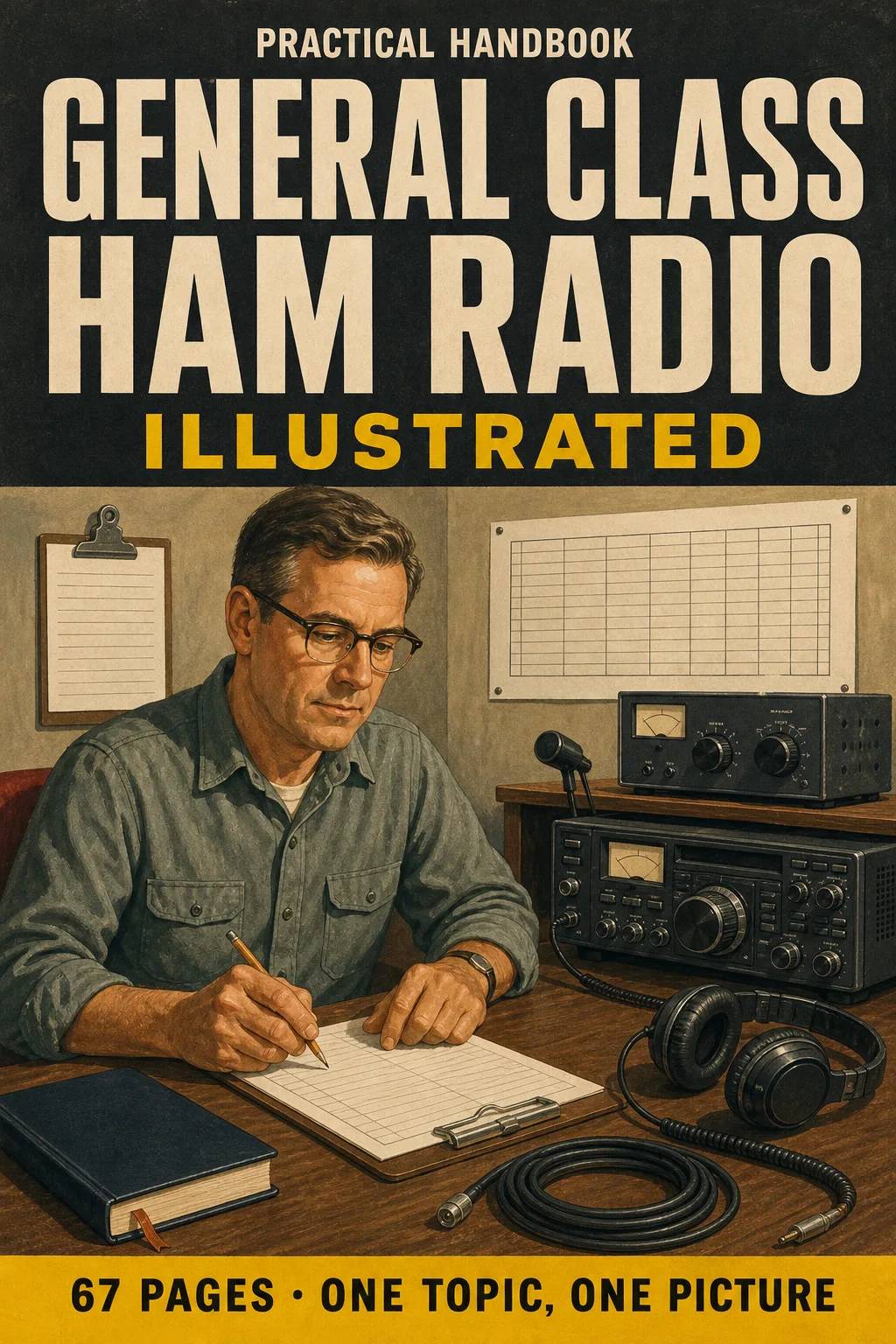
General Class Ham Radio and the Element 3 Exam, Illustrated One HF Topic on Every Page

The HF band chart, 60 meters, the ionosphere and skip, MUF, PEP and decibels, dipoles and SWR, the station block by block and the FCC Part 97 rules. Every topic has its own page: the drawing first, then what you need to remember. 67 illustrated pages.

YES, I WANT THE ILLUSTRATED BOOK

🔒 Secure checkout · PDF by email · 30-day guarantee

Every topic, its own pageEach band, layer and formula drawn, with the explanation right beside it
67 illustrated pages9 parts, from what General adds to your license to your first HF contact
Up-to-date sources2023-2027 General Class question pool and FCC Part 97
PDF by emailFormat

Look Inside the Book

Every page has one big drawing and a box with the frequencies, formulas and rules you need to know:

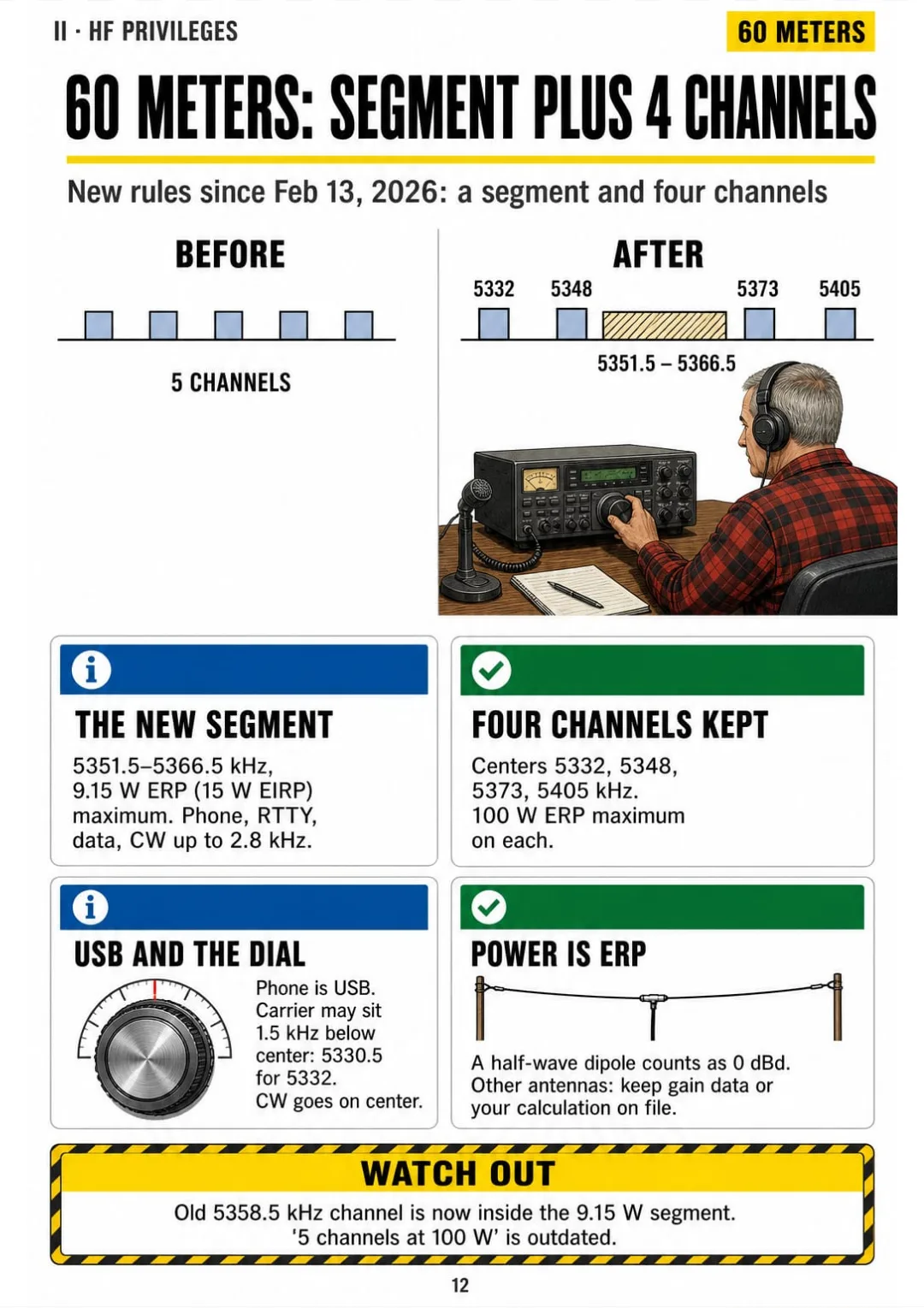
60 m since Feb 13, 2026: 5351.5–5366.5 kHz at 9.15 W ERP + 4 channels at 100 W ERP
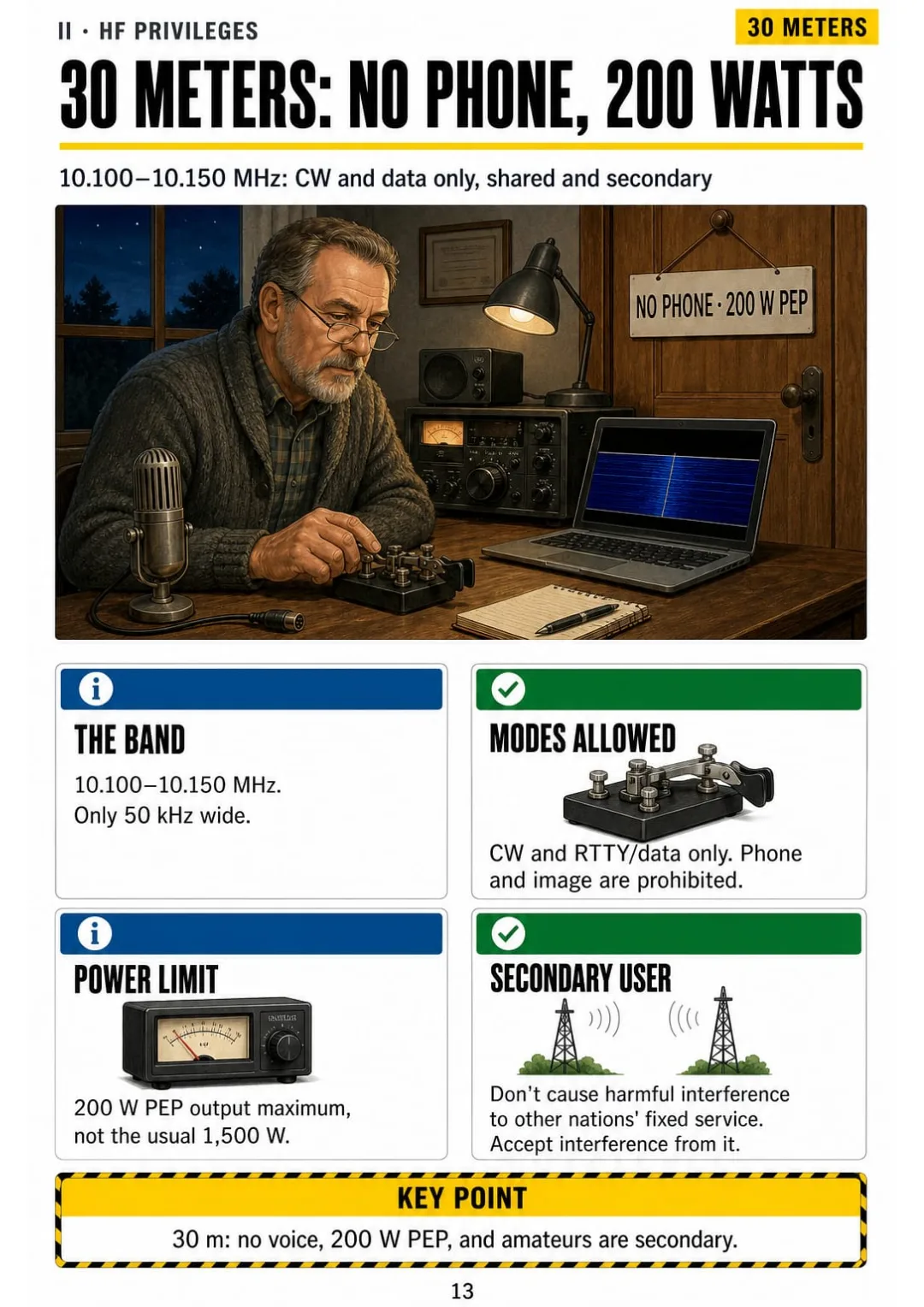
30 m: 10.100–10.150 MHz, CW and data only, 200 W PEP maximum
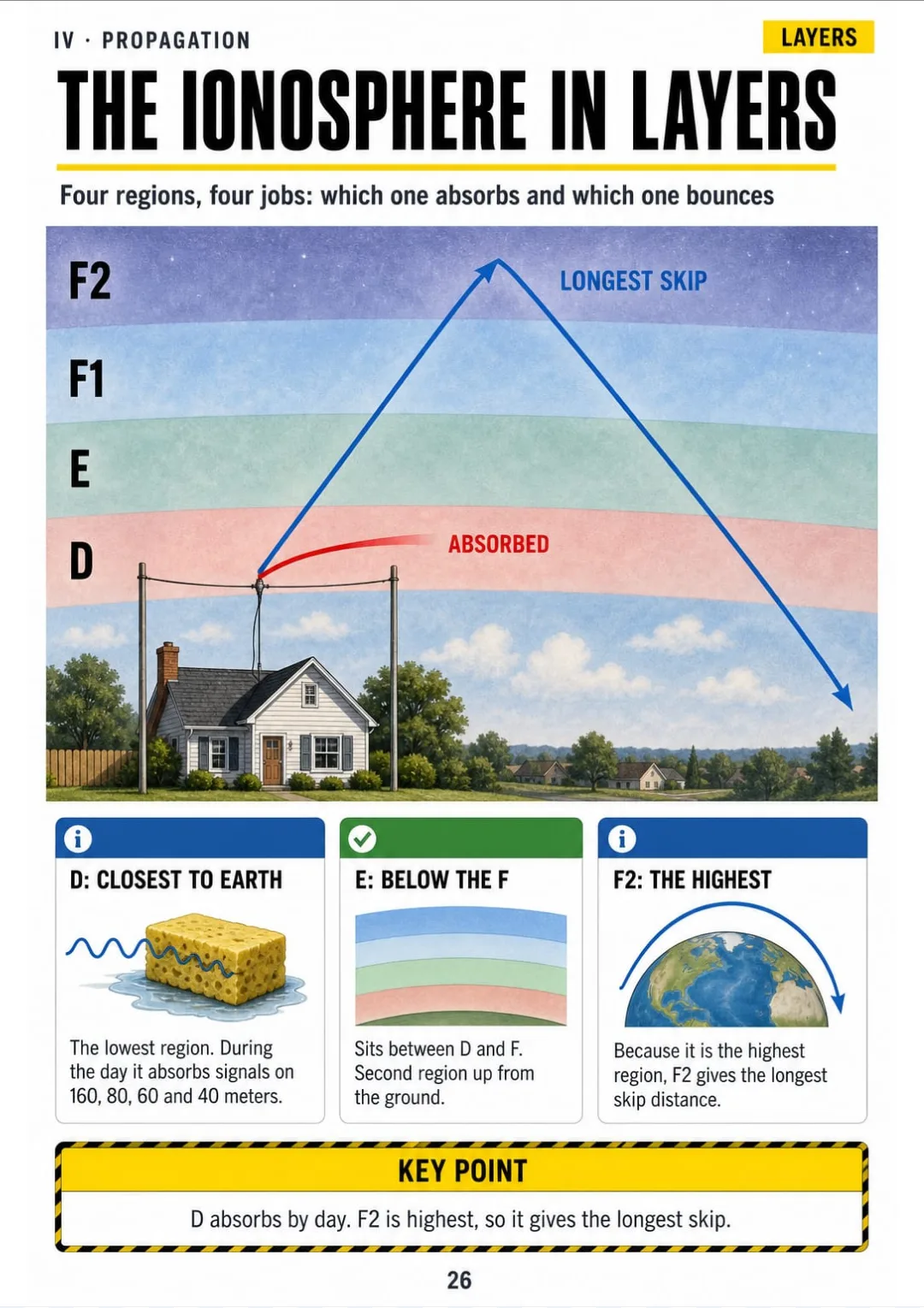
D region absorbs 160–40 m by day; F2, the highest, gives the longest skip.
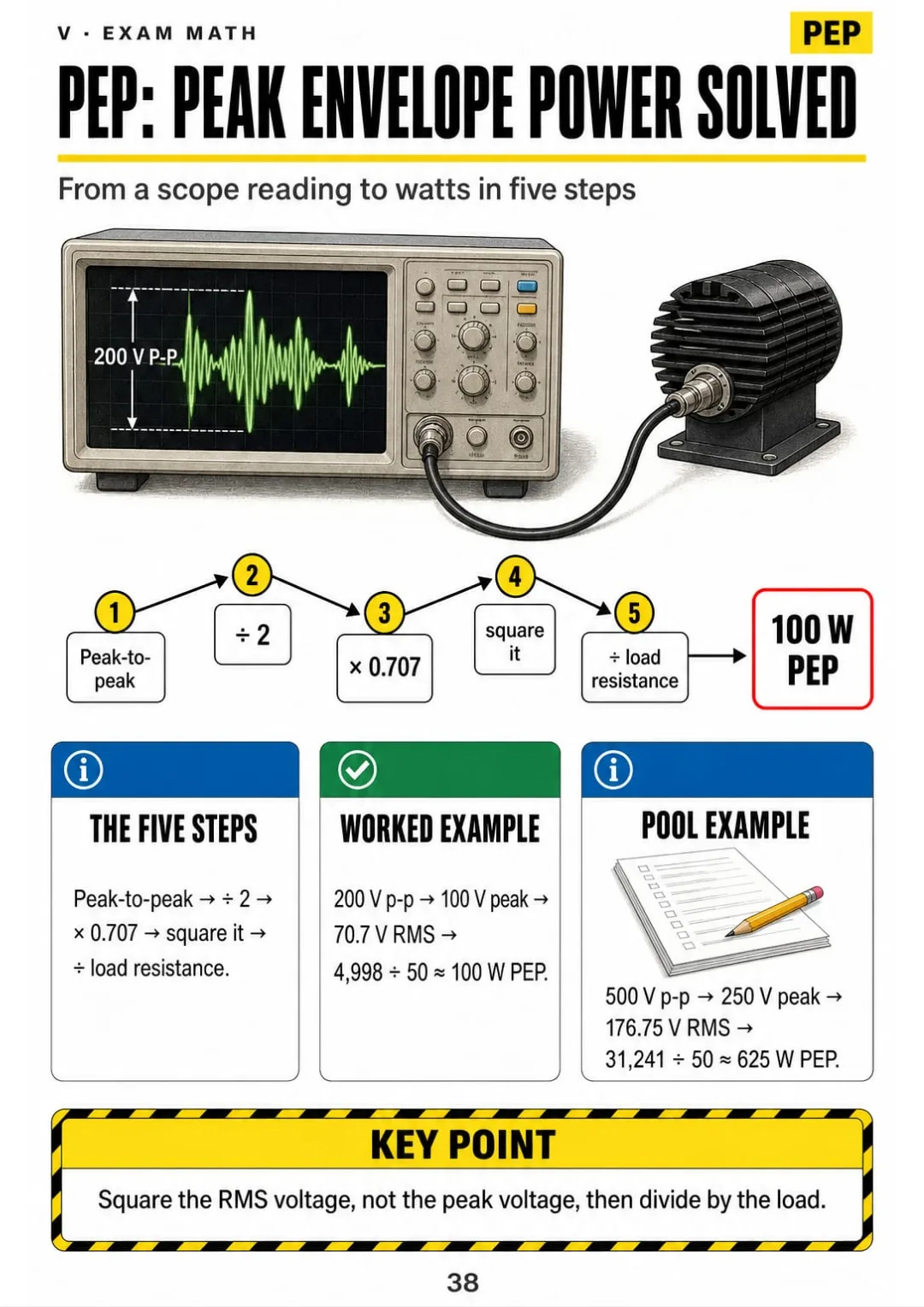
200 V p-p into 50 Ω = about 100 W PEP
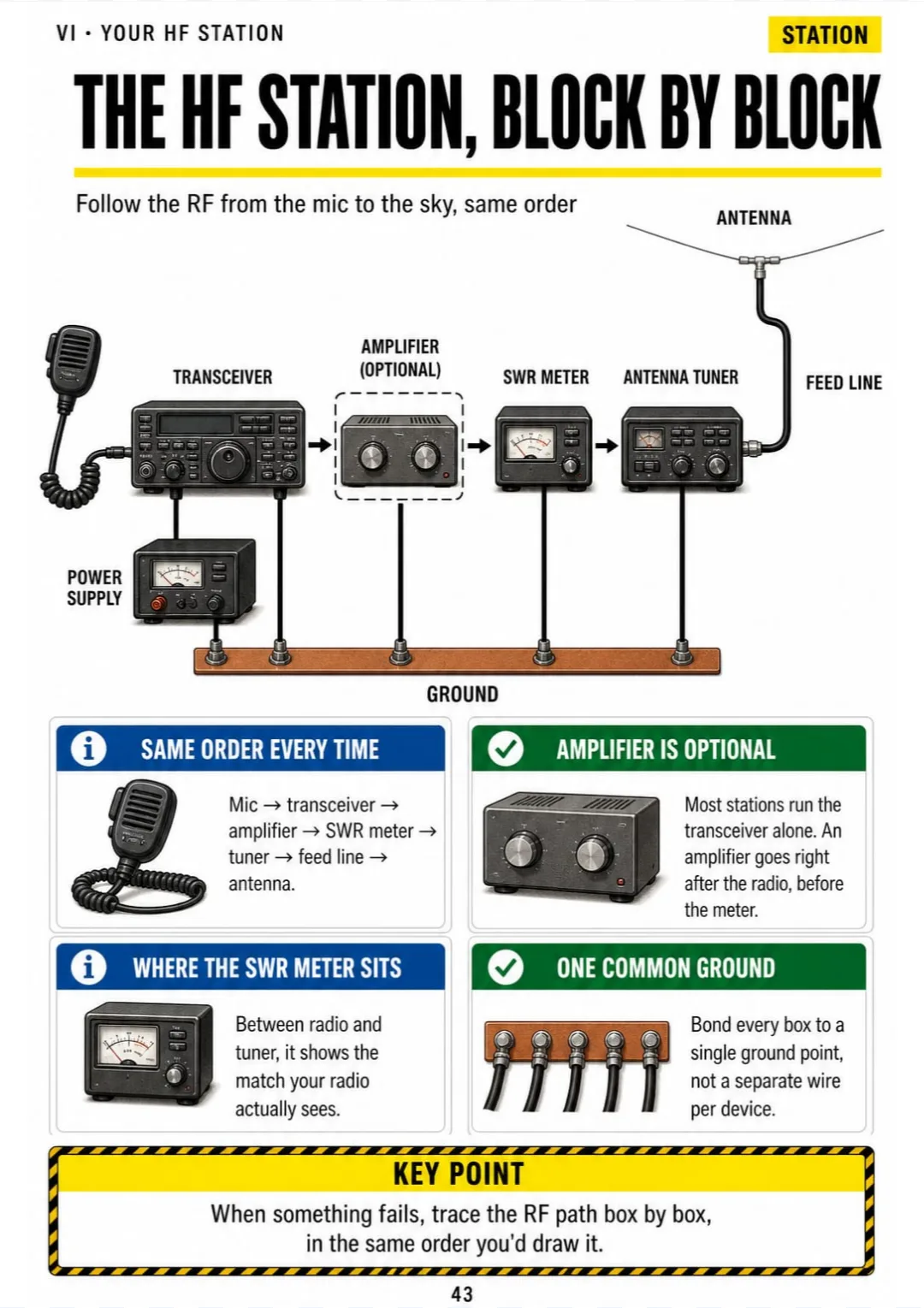
Mic → transceiver → amp → SWR meter → tuner → feed line → antenna, all to one ground
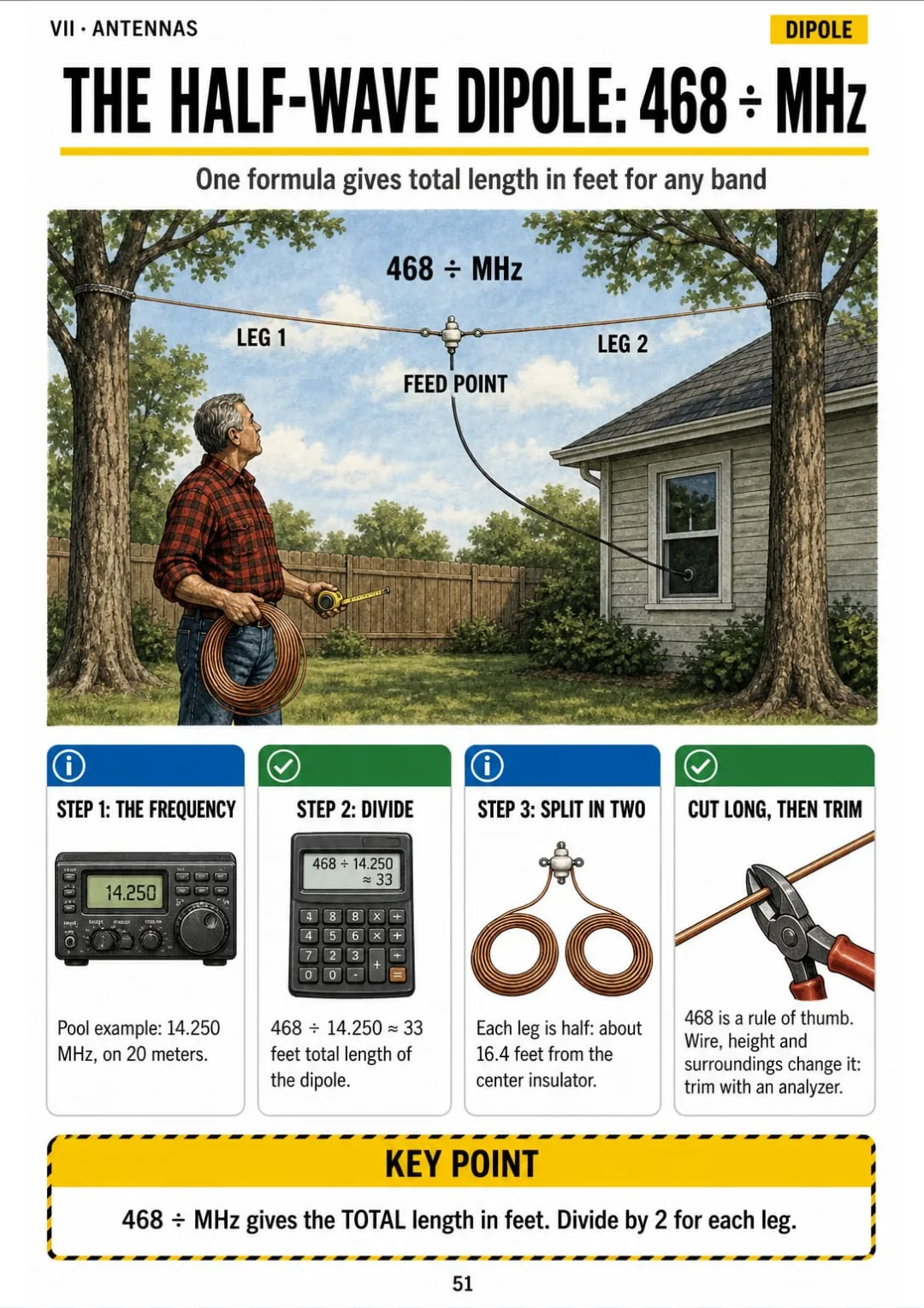
14.250 MHz → 468 ÷ 14.250 ≈ 33 feet total, about 16.4 feet per leg.
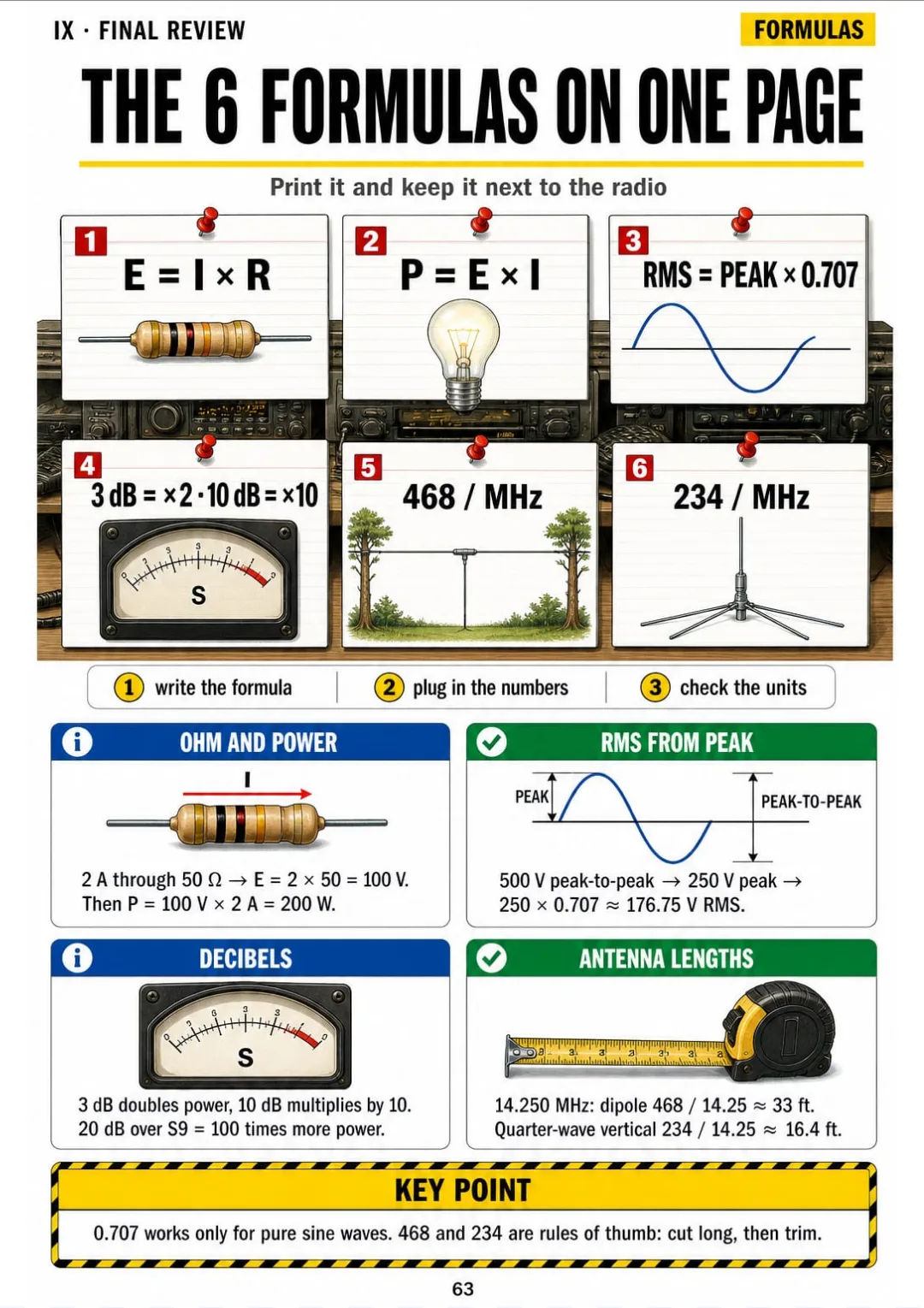
Ohm, power, RMS, decibels, 468/MHz and 234/MHz, each with a worked example
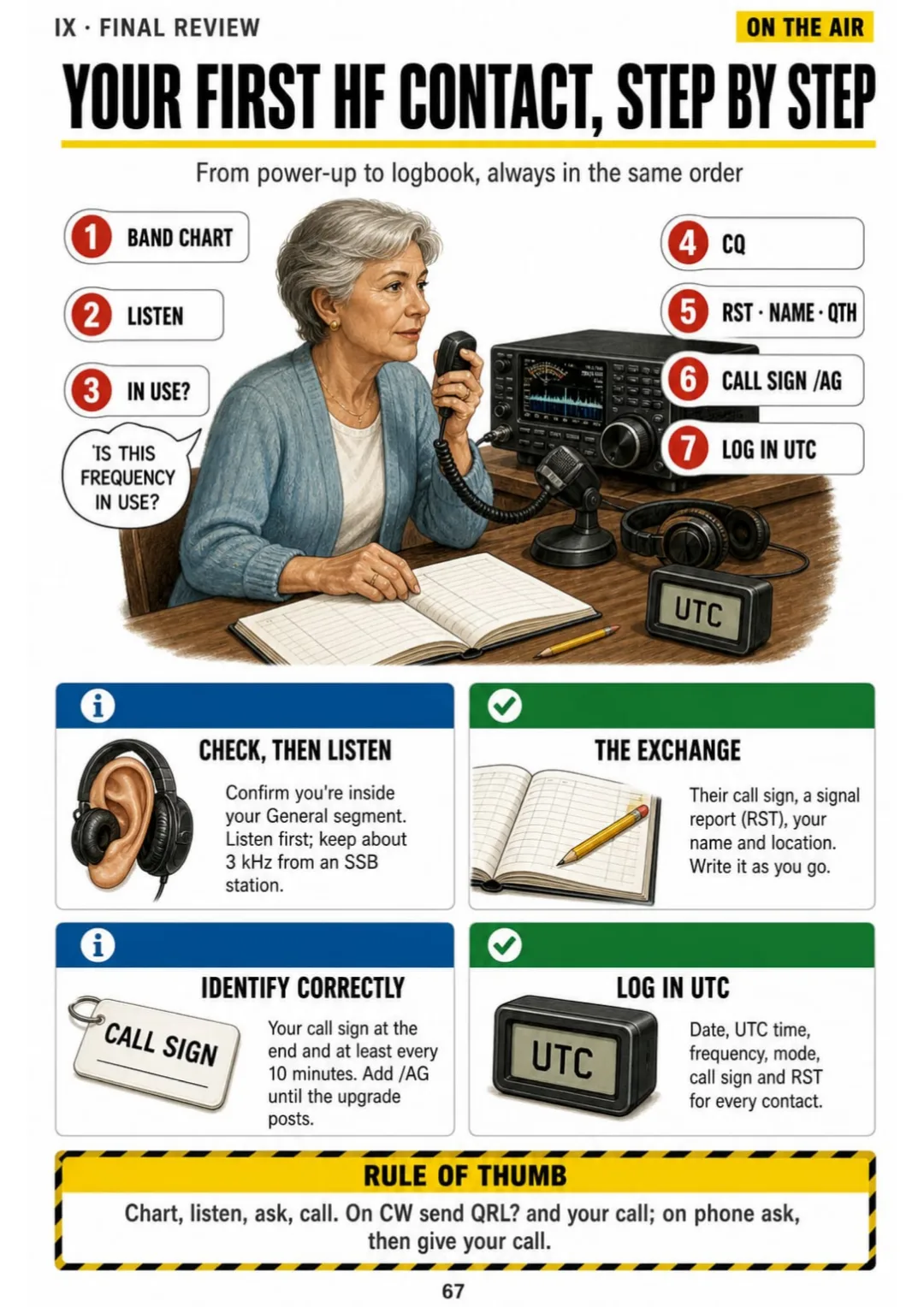
Check the chart, listen, ask, call CQ, exchange, sign with /AG, log in UTC

Swipe to see more →

These are real pages from the book. The table of contents is the full one: 9 parts and 63 topics.

The Problem Isn't You. It's How It Was Explained to You.

You're at the VE session and the question asks which layer gives the longest skip, and why 40 meters won't reach far at noon. You've seen this one a dozen times in practice tests.

The manual covers it in paragraphs: D, E, F1, F2, ionization, absorption, critical frequency. Four letters and no picture to hang them on, so the answer you memorized slips away.

D region absorbs 160–40 m by day; F2, the highest, gives the longest skip.

In this book the ionosphere is one page: the layers stacked over the Earth, the D region low and shaded, soaking up 160 to 40 meters by day, and F2 on top, bouncing your signal the farthest.

Same with the band chart, the 60-meter channels, PEP, the half-wave dipole and SWR: each one has its own page.

You read the question, picture the drawing and pick the answer. No flipping back to the manual.

COMPARE FOR YOURSELF

The Same Topic, Two Ways to Study It

THIS
  • The manual: line after line
  • Frequencies and power limits explained only in words
  • You walk into the session still unsure
Pursuant to the amended rules effective February 13, 2026, amateur operation in the 60-meter allocation comprises a contiguous segment extending from 5351.5 kHz to 5366.5 kHz, within which the maximum effective radiated power is limited to 9.15 W ERP referenced to a half-wave dipole, in addition to four discrete channels on which stations may continue to operate with up to 100 W ERP, subject to the applicable emission bandwidth and channel center requirements, and on a secondary basis with respect to other services.
FOR THIS
  • 60 meters in one drawing
  • The frequencies and watts in a box
  • You see it and you get it
30 m: 10.100–10.150 MHz, CW and data only, 200 W PEP maximum
CONTENTS

Take a Look at the 9 Parts and 63 Topics

Before you start, HF privileges and FCC rules, operating on HF, propagation, the exam math, your station, antennas and feed lines, safety and a final review: 67 pages, all illustrated.

IBefore You Start · pp. 5-9
  1. What General Class Adds to Your Technician License
  2. The Exam at a Glance: 35 Questions, 26 to Pass
  3. How to Use This Book: One Picture per Topic
  4. Exam Day at a VE Session
  5. After You Pass: The /AG Identifier
IIYour HF Privileges and FCC Rules · pp. 10-18
  1. The HF Band Chart for a General, Color by Color
  2. 160, 80 and 40 Meters: The Night Bands
  3. 60 Meters: A Segment Plus 4 Channels
  4. 30 Meters: The Quiet Band with a Power Limit
  5. 20, 17, 15, 12 and 10 Meters: The DX Bands
  6. Don't Transmit on the Edge
  7. Power Limits: 1,500 Watts PEP and Less
  8. Station ID, Control Operator and Third-Party Traffic
  9. Beacons, Remote Control and Volunteer Examiners
IIIOperating on HF · pp. 19-25
  1. Which Sideband: LSB Below 10 MHz, USB Above
  2. Before You Call CQ: Listen, Then Ask
  3. Q Signals and RST You Hear Every Day
  4. CW on HF: Speed, Zero Beat and Break-In
  5. Digital Modes: FT8, PSK31, RTTY and Winlink
  6. Nets, Contests and Emergency Traffic
  7. Interference, Logging and Good Practice
IVPropagation: How HF Skips · pp. 26-33
  1. The Ionosphere in Layers: D, E, F1, F2
  2. Day and Night: Why 40 Meters Changes at Sunset
  3. Skip Distance and the Skip Zone
  4. MUF and LUF: The Usable Window
  5. The Sun: Sunspot Cycle and Solar Flux
  6. Geomagnetic Storms: K Index and A Index
  7. Sporadic E, Gray Line and Long Path
  8. NVIS: Close-In Coverage for Emergencies
VThe Exam Math in 3 Steps · pp. 34-42
  1. The 3-Step Method for Every Calculation
  2. Ohm's Law: The E-I-R Triangle
  3. Power: P = E × I
  4. Peak, Peak-to-Peak and RMS
  5. PEP: Peak Envelope Power Solved
  6. Decibels Without Fear: 3, 6 and 10
  7. Resistors and Capacitors in Series and Parallel
  8. Transformers: Turns Ratio Does the Work
  9. Reactance and Resonance in One Picture
VIYour HF Station: Components and Signals · pp. 43-50
  1. The HF Station as a Block Diagram
  2. Inside the Receiver: Mixer, IF and Image
  3. Filters, AGC and Noise Blankers
  4. Transmitter Basics: Splatter and ALC
  5. Linear Amplifiers: Tuning and Neutralizing
  6. Semiconductors and Tubes You Need to Recognize
  7. Test Gear: Scope, Analyzer and Dummy Load
  8. RF Interference: Finding and Fixing It
VIIAntennas and Feed Lines · pp. 51-58
  1. The Half-Wave Dipole: 468 Divided by MHz
  2. The Quarter-Wave Vertical and Its Radials
  3. Feed Point Impedance and Antenna Height
  4. SWR: What the Meter Is Telling You
  5. Feed Lines: Coax vs. Ladder Line
  6. Antenna Tuners: What They Fix and What They Don't
  7. Yagis and Beams: Gain and Front-to-Back
  8. End-Feds, Loops and Multiband Antennas
VIIIElectrical and RF Safety · pp. 59-62
  1. RF Exposure: Evaluating Your Station
  2. Grounding, Lightning and the Shack
  3. AC Power Safety: Fuses, Breakers and Generators
  4. Towers and Antennas: Working Up High
IXFinal Review · pp. 63-67
  1. The 6 Formulas on One Page
  2. Band Edges in One Glance
  3. The Most Frequent Mistakes
  4. The Last Week Before the Session
  5. Your First HF Contact, Step by Step

One Page, One Topic, All Clear

Think of it this way:

It's your first evening as a General. You tune to 20 meters and want to call CQ on phone. Where exactly are you allowed to talk?

You open the band chart page and see every HF band from 160 to 10 meters in 3 colors: CW and data, phone, and the slices a General can't use on 80, 40, 20 and 15 meters.

Mic → transceiver → amp → SWR meter → tuner → feed line → antenna, all to one ground

Same with the ionosphere, PEP, the half-wave dipole, the station as a block diagram and the 6 exam formulas: each one on its own page.

General Class Ham Radio Illustrated is 9 parts and 63 topics, all drawn, and it ends with a final review: the formulas, the band edges, the most frequent mistakes and your first contact.

What you see drawn, you don't have to memorize.

What's Inside General Class Ham Radio Illustrated:

Ipp. 5-9

Before You Start

What General adds to your Technician license, the exam at a glance, how a VE session works and the /AG identifier after you pass.

IIpp. 10-18

Your HF Privileges and FCC Rules

The HF band chart by color, the night bands, 60-meter channels, 30 meters, the DX bands, band edges, power limits, station ID and control operator.

IIIpp. 19-25

Operating on HF

Which sideband to use, listening before you call, Q signals and RST, CW, digital modes, nets, contests and good operating practice.

IVpp. 26-33

Propagation: How HF Skips

The ionosphere in layers, day and night, skip zone, MUF and LUF, the sunspot cycle, K and A index, sporadic E, gray line and NVIS.

Vpp. 34-42

The Exam Math in 3 Steps

The 3-step method, Ohm's law, power, RMS, PEP, decibels, series and parallel, transformers, reactance and resonance.

VIpp. 43-50

Your HF Station: Components and Signals

The station as a block diagram, the receiver, filters and AGC, splatter and ALC, linear amplifiers, test gear and RF interference.

VIIpp. 51-58

Antennas and Feed Lines

The half-wave dipole in feet, verticals and radials, feed point impedance, SWR, coax vs. ladder line, tuners, Yagis and multiband antennas.

VIIIpp. 59-62

Electrical and RF Safety

RF exposure evaluation, grounding and lightning, AC power safety and working on towers.

IXpp. 63-67

Final Review

The 6 formulas on one page, band edges at a glance, the most frequent mistakes, the last week before the session and your first HF contact.

At the end of the book: A final review with the 6 formulas on one page, the band edges at a glance and the most frequent mistakes.
Plus: 2 Free Books

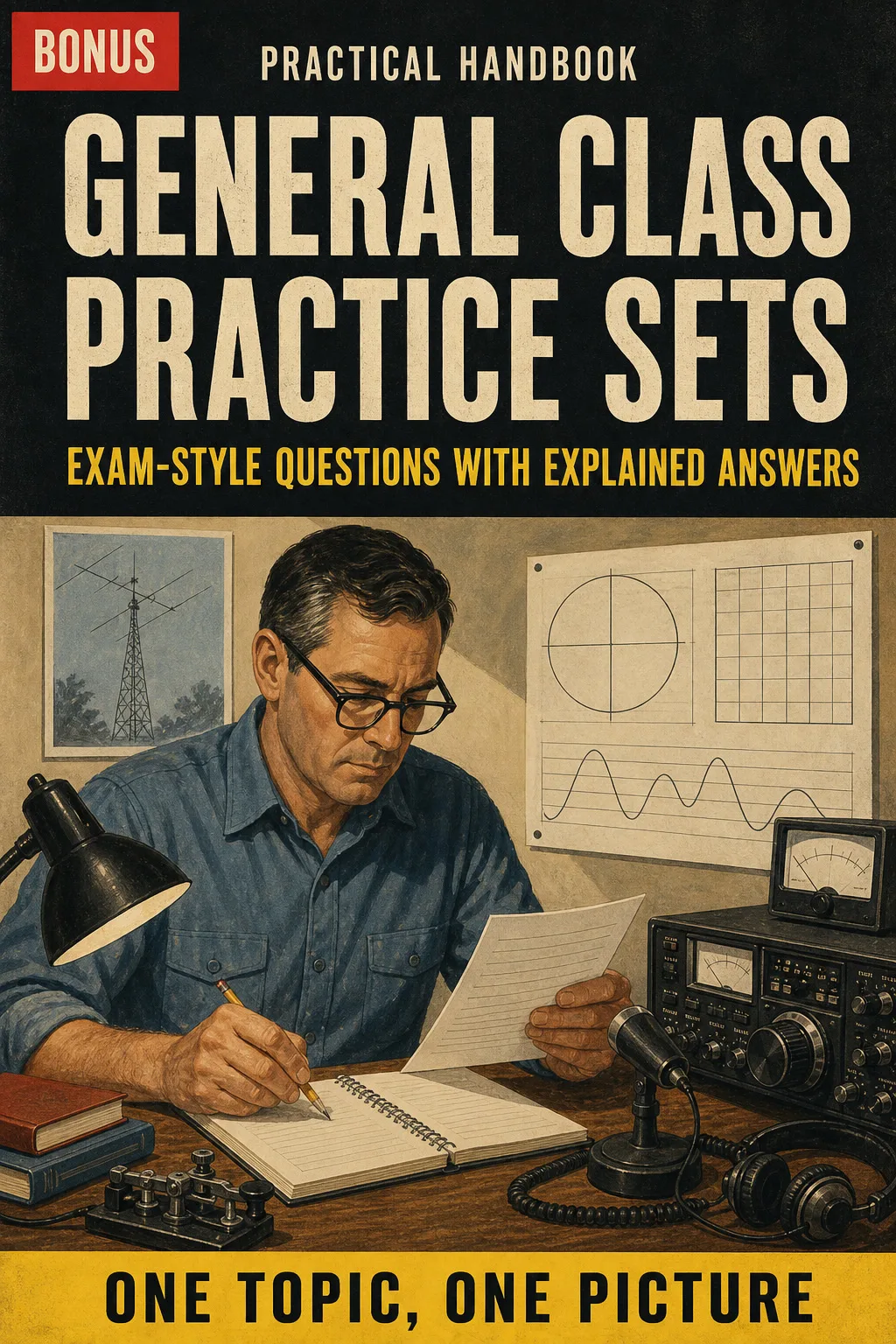
General Class Practice Sets: Exam-Style Questions with Explained Answers

BONUS 1: «General Class Practice Sets: Exam-Style Questions with Explained Answers»

Value on its own: US$ 17.90

Practice with exam-style questions grouped by topic, and see in one line why each right answer is right, so you stop guessing on test day.

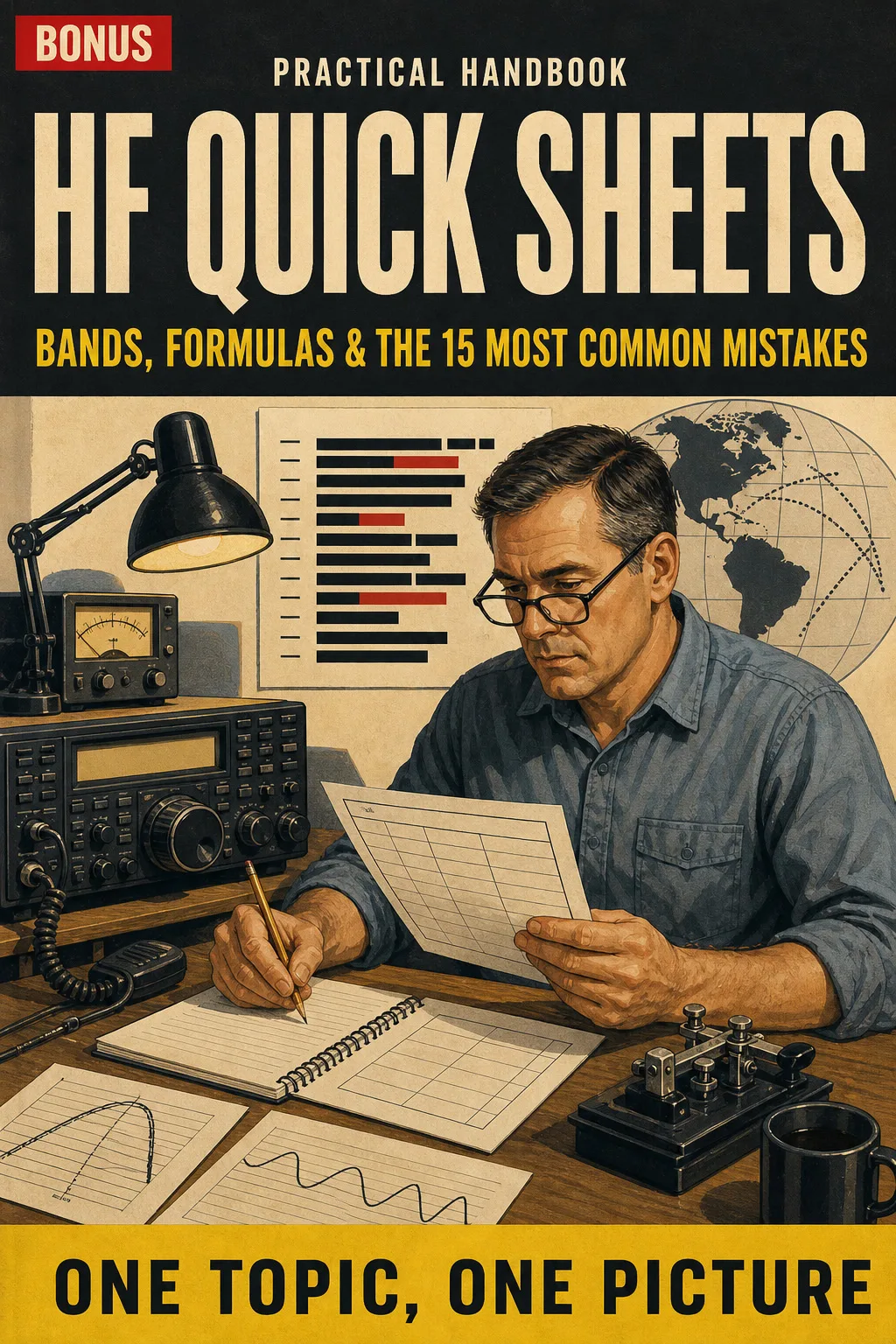
HF Quick Sheets: Bands, Formulas & the 15 Most Common Mistakes

BONUS 2: «HF Quick Sheets: Bands, Formulas & the 15 Most Common Mistakes»

Value on its own: US$ 14.90

Review the band edges, the 6 formulas and the most frequent mistakes on a few printable pages you can keep next to the radio.

General Class Ham Radio Illustrated with 2 Free Books

  • General Class Ham Radio Illustrated: 67 illustrated pagesUS$ 63
  • BONUS 1: General Class Practice Sets: Exam-Style Questions with Explained AnswersUS$ 17.90
  • BONUS 2: HF Quick Sheets: Bands, Formulas & the 15 Most Common MistakesUS$ 14.90
  • High-resolution PDF to printIncluded
Total value US$ 95.80
YOUR PRICE:
US$ 27
You save US$ 68.80
YES, I WANT GENERAL CLASS HAM RADIO ILLUSTRATED FOR US$ 27

📄 This is a digital PDF book sent to your email: nothing is printed or shipped.

Secure purchaseEncrypted payment30-day guarantee

PDF by email: We email you General Class Ham Radio Illustrated as a PDF, together with the two free books. It's a single payment: no installments, no extra charges.

Who This Book Is For

You're studying for General

You're studying for General

Every pool topic on its own drawn page, so bands, skip and the math finally connect instead of staying loose answers.

Your VE session is close

Your VE session is close

The final review puts the 6 formulas, the band edges and the most frequent mistakes on a few pages you can go over the night before.

You're already on HF

You're already on HF

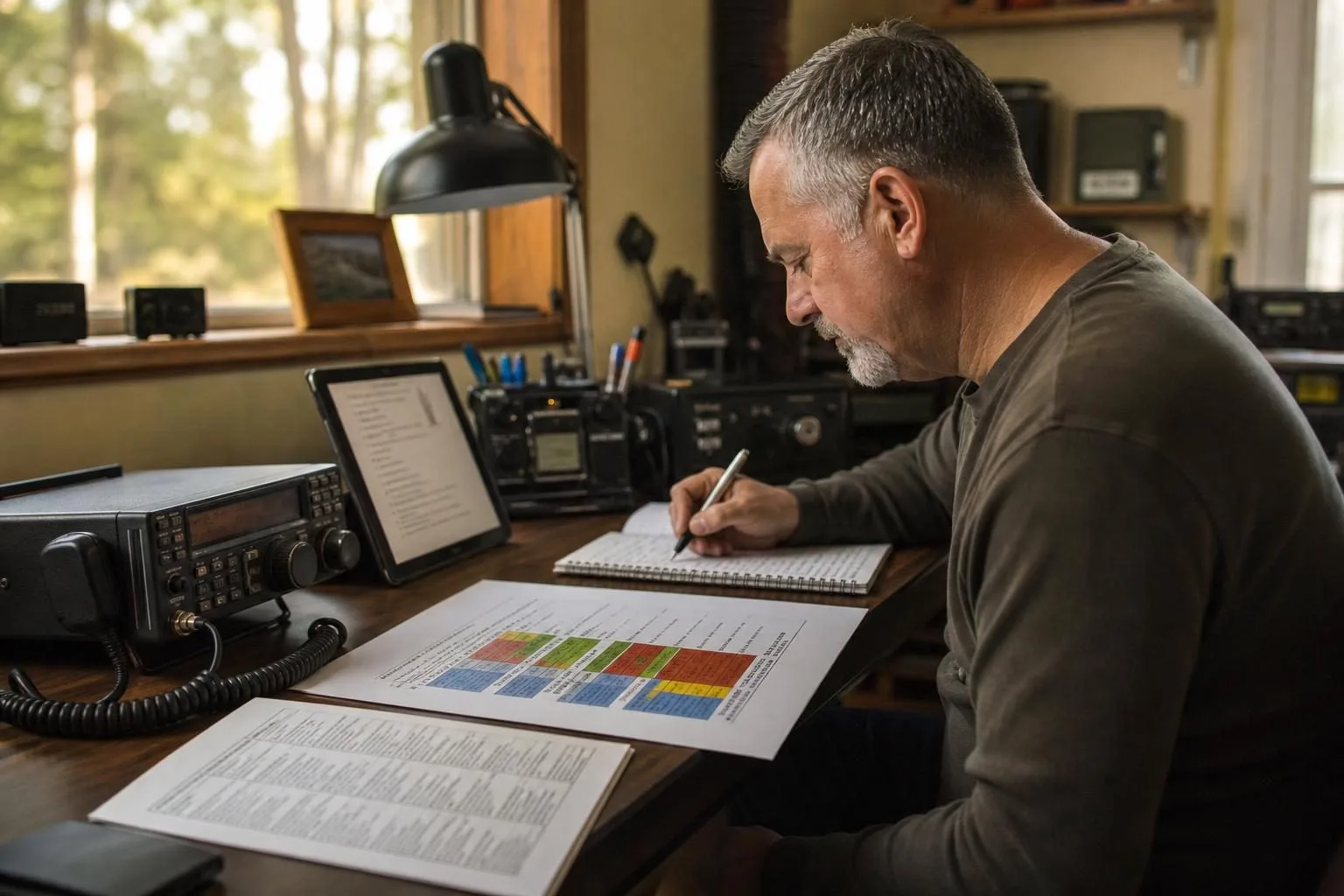
Print the band chart and the first-contact page and keep them by the radio, so you know where you can transmit and why.

Everything You Get Today

US$ 95.80US$ 27
YES, I WANT GENERAL CLASS HAM RADIO ILLUSTRATED FOR US$ 27

📄 This is a digital PDF book sent to your email: nothing is printed or shipped.

30DAYS
GUARANTEE

30-Day Guarantee

Try General Class Ham Radio Illustrated for 30 days, bonus books included.

We refund everything if the file won't open, if the book isn't what you see here, if you were charged twice or if the email doesn't arrive. Just email us.

You pay once. No subscriptions.

Frequently Asked Questions

Is it for me if I've had my Technician license for years and the math scares me?

Yes. It starts from what you already know as a Technician, and every calculation is solved in the same 3 steps: what you're given, which formula, what number comes out. A basic calculator is all you need, the same kind you can bring to the VE session.

Where does the content come from?

From the 2023-2027 General Class (Element 3) question pool and the FCC amateur radio rules, Part 97. Frequencies and limits are checked against both. Where a rule changed after the pool was released, as on 60 meters, the page shows the current rule and notes the change. Always confirm against the current official text.

Is it official material?

No. It's an independent illustrated study book, not issued or endorsed by the FCC, the NCVEC or any VEC. It doesn't give you a license or certificate: your General privileges come only from passing Element 3 at a VE session.

Does it replace a class or the official question pool?

No, and keep doing the free practice tests: they tell you which answer is right. This book shows you why, one drawing per topic, so when a question is worded differently you still recognize it. It doesn't replace the pool, a class or practice with other operators.

Are the practice questions the ones on the exam?

No. They are exam-style questions written for this book, grouped by topic, with a one-line explanation of each answer.

When and how do I get it?

The book and the 2 bonus books arrive as PDFs by email, at the address you enter at checkout.

Do I have to pay every month?

No. It's a one-time payment.

Can I have it on paper?

Yes. The PDF is made to print, so you can keep the band chart and the formulas on the desk next to your radio.

How does the refund work?

You have 30 days. We refund everything if the file won't open, if the book isn't what you see on this page, if you were charged twice or if the email doesn't arrive: just email us.

Before You Close This Page

No more rereading without it sticking.

The band chart and skip: you see them drawn and that's it.

You walk into the VE session knowing where everything is.

Drawings make studying faster.

The book is right below.

One-time payment: US$ 27 · Guarantee: 30 days · PDF by email

YES, I WANT GENERAL CLASS HAM RADIO ILLUSTRATED FOR US$ 27

📄 This is a digital PDF book sent to your email: nothing is printed or shipped.